

By Allison Levine, Coordinator of STEAM Integration, and Sarah Rolle, Director of Technology
As Generative AI continues to evolve, Rodeph Sholom School remains committed to educating our community through a thoughtful, values-based lens. We have developed a comprehensive AI Framework designed as an intentional extension of our mission to prepare students to thrive in an ever-evolving world. Our approach is grounded in the core values that guide us: developing a love of learning (limmud), a sense of responsibility (kehilah), and a commitment to community (achrayut).
This alignment ensures that AI enhances—rather than replaces—meaningful exploration, strengthens ethical decision-making, and supports our vision of inspiring curious learners to become purpose-driven leaders.
Developing the Framework
Our AI Framework consists of three key components: a Vision for AI Usage, Guidelines for Faculty, and Guidelines for Students. To build this foundation, we engaged in extensive research, examining successful AI programs at other independent schools and reviewing recommendations from leading professional educational organizations.
This research-led process also involved vetting software to provide safe environments for students to practice using AI under teacher guidance. By developing specific learning modules, we aim to help students understand the mechanics of Generative AI so they can critically evaluate the information it provides.
Professional Development and Faculty Literacy
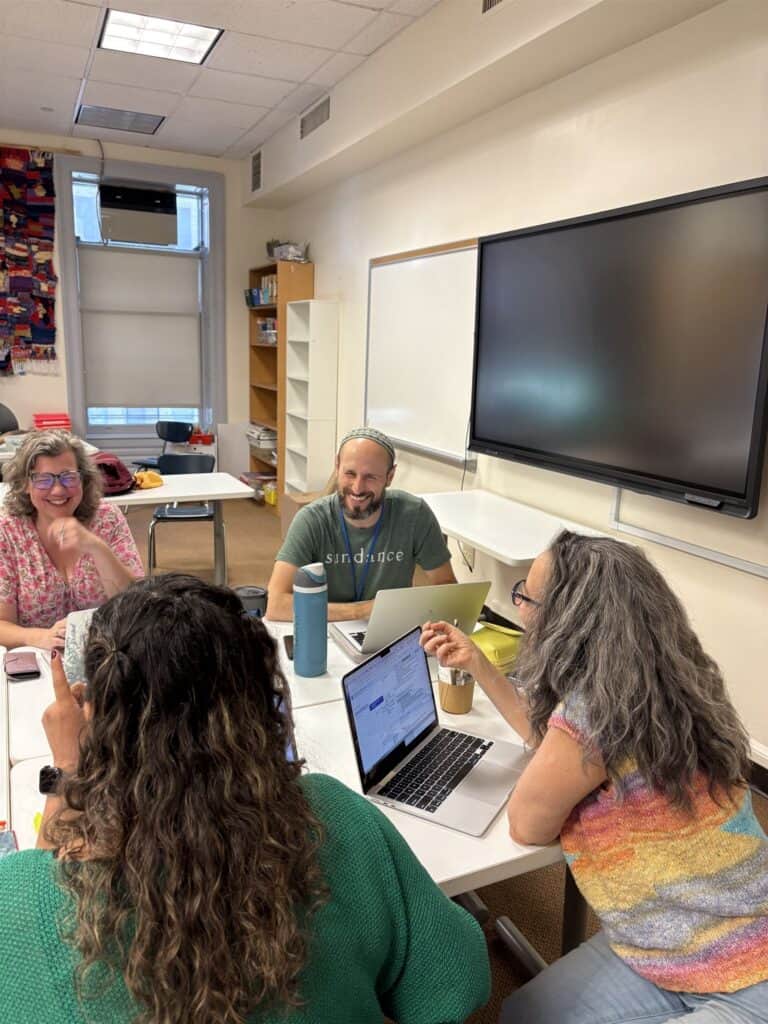
A critical component of our rollout is ongoing faculty education. Teachers across all divisions engage in professional development focused on the school’s guidelines for AI use, emphasizing that these tools are meant to support—not replace—relationships, reflection, and meaningful learning experiences.
Training sessions focus on:
Differentiated Learning: Teachers explore how AI can meet diverse academic needs through text leveling and varied engagement strategies, ensuring the technology serves to enhance student support without replacing strong instruction.
Prompt Engineering: Teachers practice writing effective prompts to collaborate with AI effectively, preparing them to teach this skill to students in an age-appropriate way.
Critical Evaluation: Faculty use a critical lens to evaluate AI-generated content for quality and bias.
Student AI Literacy
We believe it is essential for students to understand what AI is, how it works, and its ethical implications before using it in a school setting. To achieve this, students participate in dedicated AI Literacy programming. Through interactive activities, games, and discussions, they explore:
- Large language models and machine learning.
- Ethics, bias, and the societal implications of AI.
- Essential skills, including prompt writing and critiquing AI output.
This literacy-first approach prepares students for a supervised phase of implementation, where they eventually gain access to safe AI tools for specific, guided tasks.
Looking Ahead
The use of AI at Rodeph Sholom School will continue to evolve alongside the technology itself. Our goal is to ensure that AI is used appropriately to support our educational mission, providing students with the literacy and judgment to apply these tools responsibly. By approaching AI with curiosity and discernment rather than fear or dependency, we remain committed to cultivating the skills our students need to contribute positively to the world.